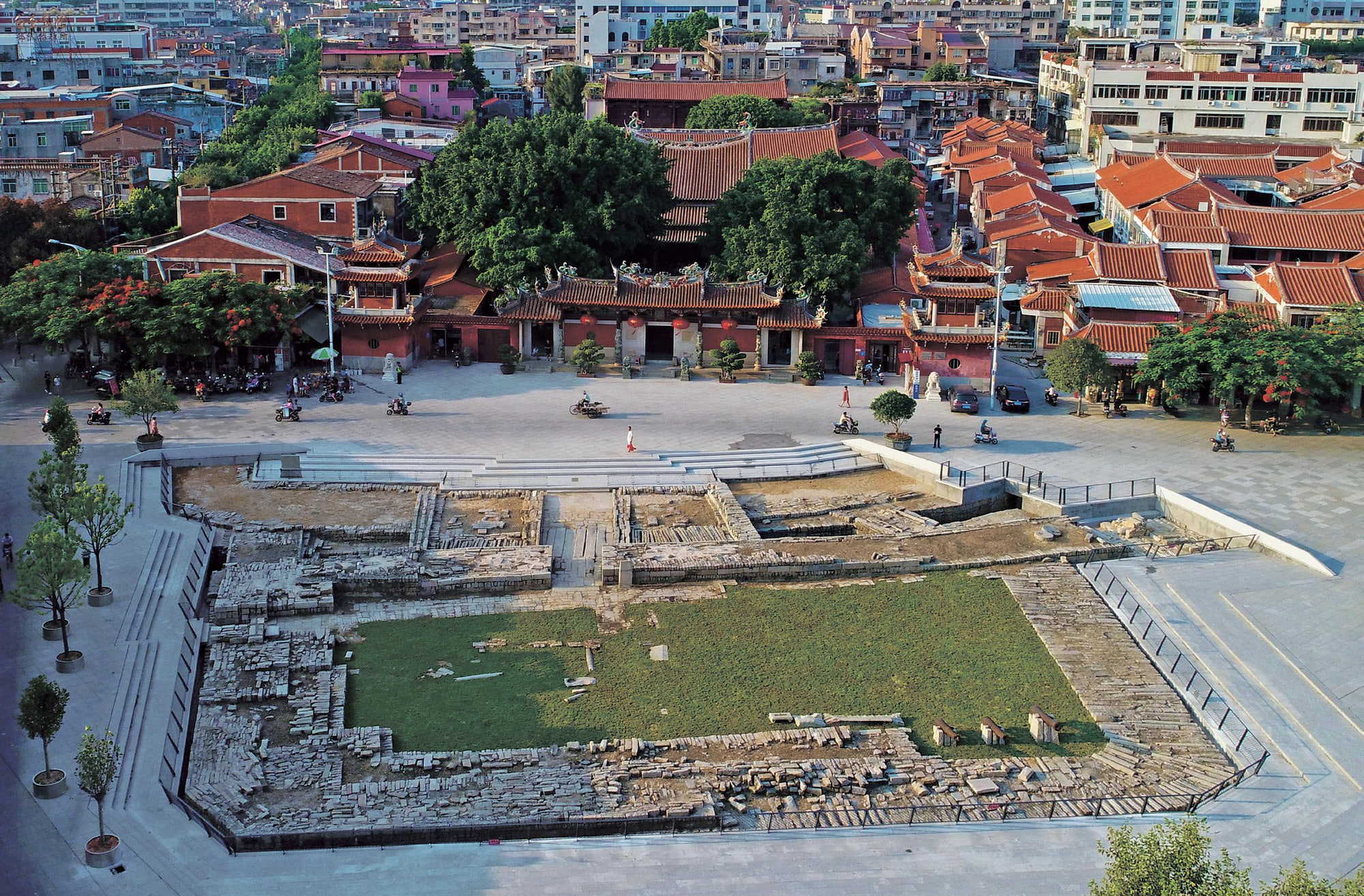
The archaeological remains of Deji Gate beside Tianhou Temple in Quanzhou

City gate archaeology · Historic Downtown

Site of Deji Gate

Low stone foundations reveal where the old city opened towards the river, docks and overseas world.

Chinese map name
德济门遗址 Site of Deji Gate
Role in the port
Urban gateway between city and port
Historic period
Gate begun in 1230; rebuilt through later dynasties
Time on site
Allow 30-45 minutes

德济门遗址

How do foundations and fragments explain the movement of a world port?

Deji Gate was the southern entrance to Quanzhou's walled city, close to the Jin River and opposite Tianhou Temple. The first southern gate in this area was built in 1230. It was expanded in 1352, repaired and altered through the Ming and Qing periods, and lost its gate tower to fire in 1948. Archaeological work in 2001 brought the buried structure back into view.

What remains is not a picturesque city gate standing at full height. It is an archaeological plan made of foundations, walls, channels and surfaces. That may seem visually modest, but it preserves something more useful: the changing footprint of the city's southern edge across several dynasties.

Goods arriving from overseas and products moving out towards ships passed through this zone. The site therefore helps answer a basic question that temple interiors cannot: where did the port meet the organised space of the city?
On site

What to look for

The site becomes more legible when you know which physical clues carry its larger story.

Start with the whole setting, then move closer. Architecture, archaeology and landscape often reveal different parts of the same argument.

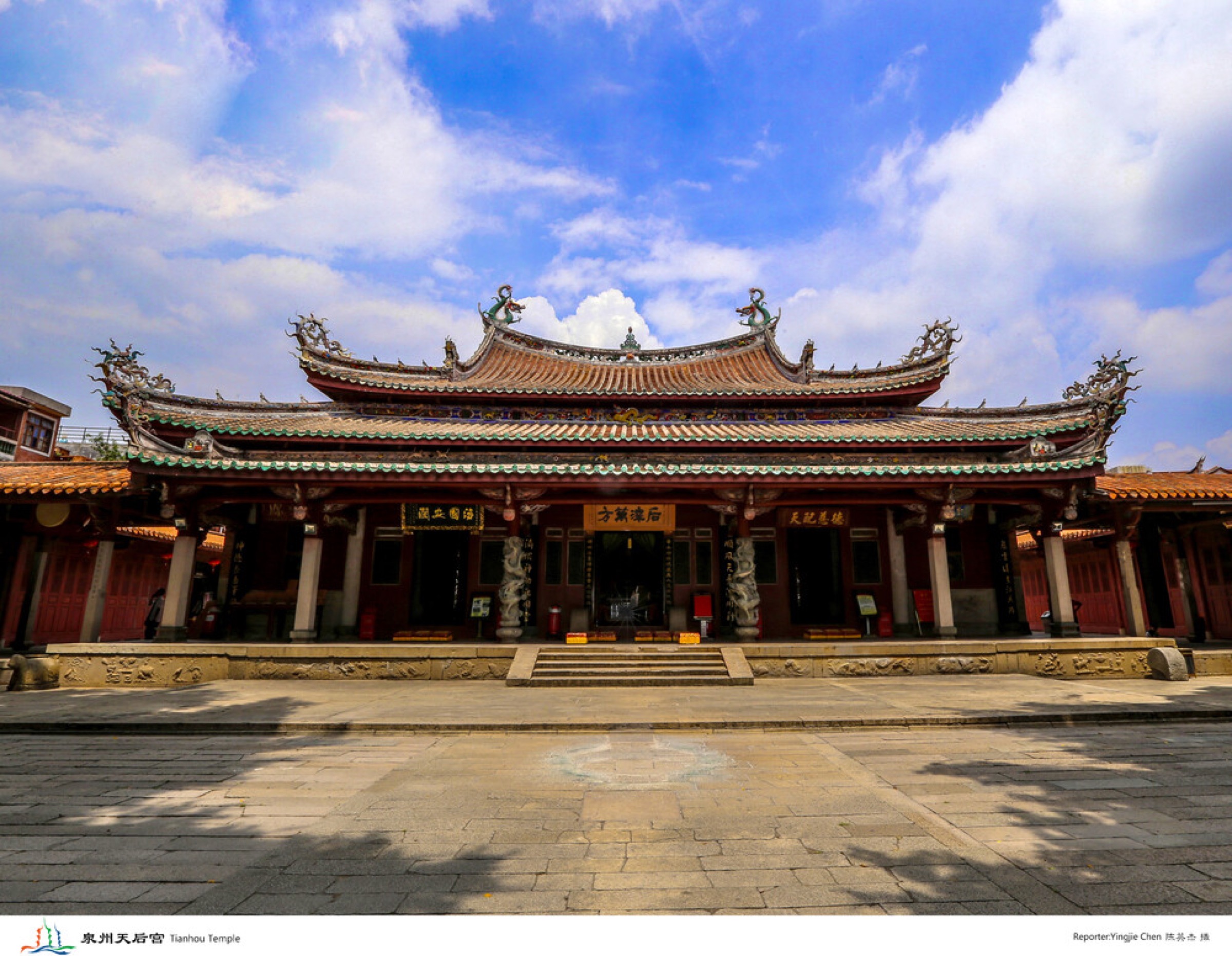
Tianhou Temple beside the southern approach to Deji Gate

01

Several periods in one ground plan

Follow changes in wall direction, width and construction rather than searching for one complete gate. Song, Yuan, Ming and Qing layers overlap across the excavated area.

02

Moat, bridge and barbican

The inner moat, stone bridge, gate passage and defensive enclosure show that entry was channelled and controlled. These are the working parts of an urban threshold.

03

Reused religious stonework

Carved fragments associated with Christianity, Islam, Hinduism and Buddhism were found in the site. They are evidence of the material and human diversity present in Song-Yuan Quanzhou, as well as later reuse.

04

The river-facing orientation

Look beyond the excavation towards Tianhou Temple and the city's southern streets. The wider setting explains the gate better than any single stone block.

The archaeological remains of Deji Gate beside Tianhou Temple in Quanzhou

Read the port system

A world port still needed walls, checkpoints and controlled movement

Quanzhou's maritime openness did not mean an unstructured city. Deji Gate represents the regulated movement of cargo and people between river routes, port districts and the urban centre. Its successive rebuilding also records how the city expanded and adjusted as trade patterns changed.

The foreign religious carvings discovered here should be read carefully. They do not by themselves prove an idealised story of permanent harmony. They do show that communities connected to several religious traditions left a physical presence strong enough to enter the city's later building fabric.

See all 22 component sites

Research lens

What scholarship adds to the visit

Deji Gate is most useful as urban archaeology: it shows how the walled city opened towards river traffic, docks and the southern commercial districts.

01

A threshold between city and port

The archaeological sequence identifies successive gate works and road surfaces at Quanzhou's southern approach. In the nomination's system model, this was a hinge between urban administration and movement towards the Jin River.

Read the source

Quanzhou World Heritage nomination dossier (2020)

02

Foreign communities shaped urban form

Clark argues that Muslim and Hindu communities were not peripheral visitors but helped shape Quanzhou's culture and morphology. The gate's proximity to religious and commercial districts makes that urban argument visible on foot.

Read the source

Hugh R. Clark, ‘Muslims and Hindus in the Culture and Morphology of Quanzhou’ (1995)

03

Setting is part of the evidence

ICOMOS repeatedly stresses that the meaning of serial components depends on their surroundings. At Deji Gate, the relationship with Tianhou Temple, former waterways and the southern street network matters more than any isolated stone.

Read the source

ICOMOS evaluation of the revised Quanzhou nomination (2021)

Plan the visit

Make the time on site count

These are planning decisions, not fixed opening-hour claims. Recheck access and transport shortly before travel.

01

Read the panels before walking the perimeter

Archaeology is easier to understand when you first identify the gate passage, moat, bridge and wall phases. A few minutes of orientation changes the entire visit.

02

Do not expect a monumental skyline

The value is spatial and archaeological. Close views of masonry changes and the relationship to the street are more revealing than a distant photograph.

03

Pair it immediately with Tianhou Temple

The two sites face each other and explain the same port threshold from different angles: one through controlled movement, the other through maritime belief.

04

Protect the site while photographing

Stay on designated paths and platforms. Do not climb onto exposed foundations or treat low walls as seating.

Connect the place

Begin a city walk at the port-facing edge

Deji Gate and Tianhou Temple make a strong first pair. Continue north on foot to the Confucius Temple and Qingjing Mosque, then decide whether to finish around Zhongshan Road or continue towards West Street.