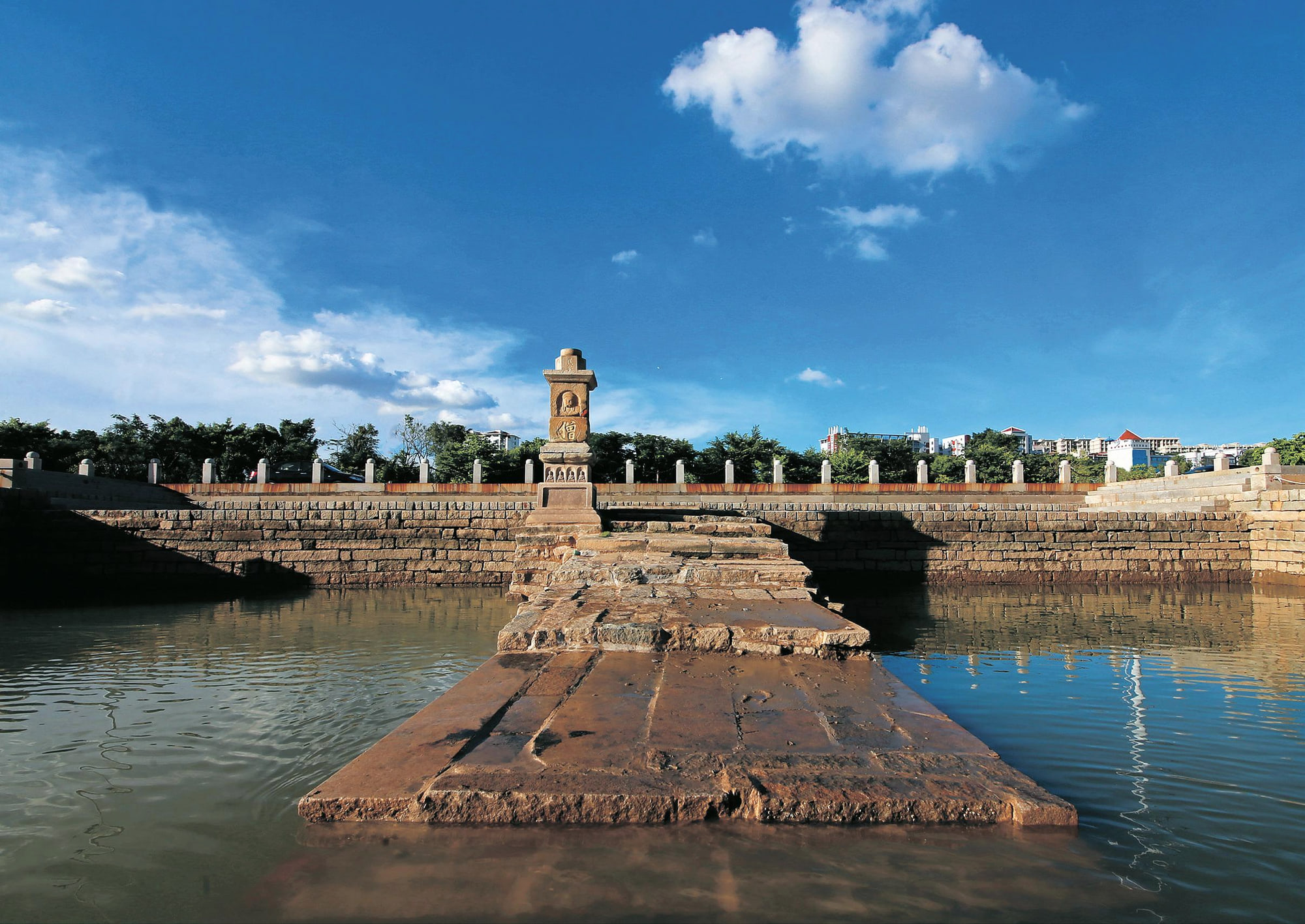
Marco Polo's Zayton
A compact portrait of a port defined by ships from India, high-value cargo and the fiscal power of maritime trade.
Explore Inside Quanzhou
 About Quanzhou · Texts across centuries
Before Quanzhou entered modern guidebooks, Zayton appeared in travel writing. Later scholars used texts, inscriptions and archaeology to ask how this maritime city actually worked.
Why outside accounts matter
These texts do not make Quanzhou important. They show how the city was encountered from beyond China and help us test what survives on the ground.
Travel writers noticed what mattered to their own journeys: ships, cargo, officials, religious houses and people they could trust. Modern historians ask different questions and compare those accounts with inscriptions, tombs, archaeology and regional trade patterns.
Medieval travel accounts
Read each account as evidence with a point of view: commercial scale, arrival through a Muslim network, and a Franciscan presence in Asia.
A compact portrait of a port defined by ships from India, high-value cargo and the fiscal power of maritime trade.
Explore
The Moroccan traveller enters China through a harbour crowded with large junks and reads the city through ships, textiles and familiar Muslim connections.
Explore A Franciscan traveller's brief notice opens a less familiar window onto Quanzhou: Latin Christian institutions within a much wider religious port city.
ExploreModern international scholarship
These studies move beyond praise. They test how foreign communities became part of the city, how identities changed and where ships could travel from Quanzhou.
Clark asks us to treat China's seaward edge as a place that shaped Chinese culture, not as a passive boundary beyond the empire's real history.
Explore
Chaffee replaces a static image of a foreign merchant colony with a community that changed across centuries of trade, migration, policy and local integration.
Explore
Ptak turns the port outward, reconstructing more than one route from Fujian through the South China Sea to island Southeast Asia and the Indian Ocean.
Explore How to read the series
Travel accounts are shaped by memory, translation and literary convention. Scholarship is shaped by its questions and available evidence. Every article therefore separates the source's claim, our plain-English interpretation and the limits of what can be concluded.
Read the editorial policyA note on names
Spellings vary because names travelled through several languages, scripts, manuscripts and translations.
01
Zayton, Zaitun, Zaytun and older European forms such as Çaiton refer to related historical transcriptions. This series preserves the spelling used by each source where practical.
02
Modern readers need a clear geographical anchor. Article titles and metadata connect the historic name to Quanzhou rather than expecting visitors to know the identification in advance.
03
A shared place-name does not make every detail in a travel itinerary reliable. Identification, chronology and individual claims still need to be checked separately.
04
Use Zayton as a question: which institutions, communities and transport systems made this port recognisable to people arriving from across maritime Asia?