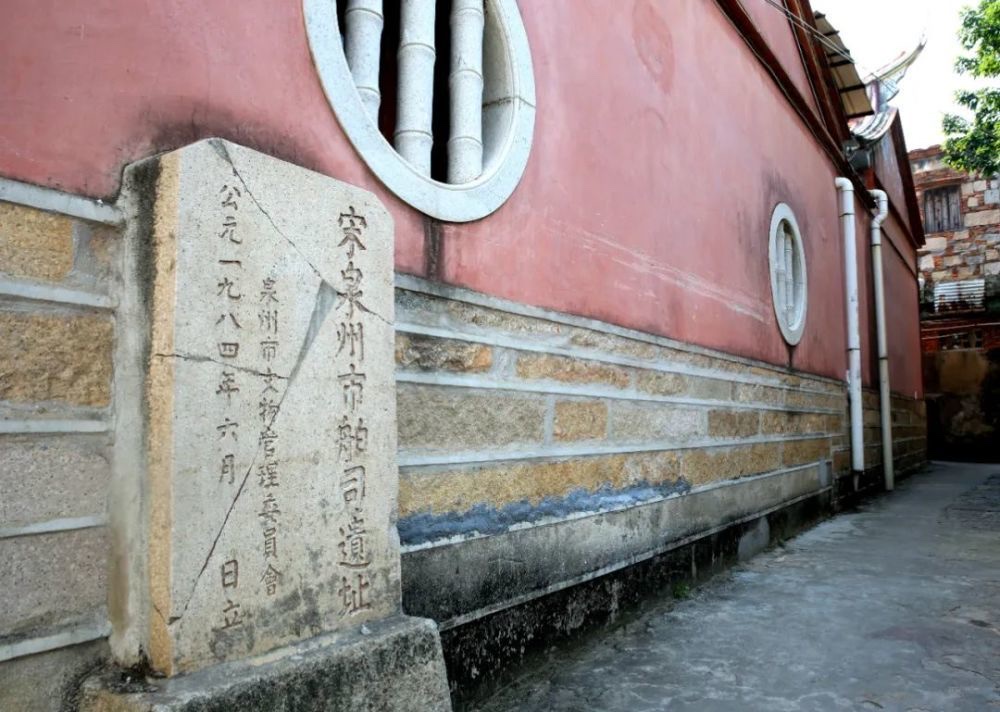
Stone site marker beside a historic lane at Quanzhou's former Maritime Trade Office

Trade administration · Historic Downtown

Site of Maritime Trade Office

A visually modest archaeological site that explains how a medieval port inspected, taxed and governed overseas trade.

Chinese map name
泉州市舶司遗址 Maritime Trade Office
Role in the port
State administration of maritime commerce
Historic period
Office founded in 1087; Song–Yuan remains
Time on site
Allow 30–45 minutes

市舶司遗址

What turned busy sea traffic into a regulated port economy?

The Song government established Quanzhou's Maritime Trade Office in 1087. Often compared loosely with a customs service, the institution handled a broader field of maritime affairs: merchant shipping, inspection, taxation, imported goods and official relations with overseas traders.

The building no longer survives as a standing government compound. Archaeology has instead identified Song–Yuan pavements in trial trenches, a ditch and broad bands of silt that help reconstruct a substantial historical waterway system. The protected area covers roughly 12,000 square metres among Maban, Ditch, Bamboo and Water Gate alleys.

That combination of buried remains and living lanes is the point of the visit. The office sat in the southern part of the old city, between defensive walls and close to the river corridor. Its location connected formal administration to the physical arrival of ships, goods and people.

On site

What to look for

The site becomes more legible when you know which physical clues carry its larger story.

Start with the whole setting, then move closer. Architecture, archaeology and landscape often reveal different parts of the same argument.

Stone marker beside the historic lane at Quanzhou's Maritime Trade Office site

01

Archaeological ground, not a reconstructed office

Use plans and labels to distinguish excavated pavements, drains and later surfaces. No source can supply a complete Song façade for the lost compound.

02

The waterway evidence

Silt layers beside the surviving ditch indicate a much wider historical channel. This helps explain why a trade office stood here even though the modern waterfront feels distant.

03

A high-status institutional site

Architectural fragments, ceramics and the scale of the precinct support the interpretation of an official complex. Small finds carry more evidentiary weight than the present entrance marker alone.

04

The surrounding lane pattern

Walk a short circuit around the four named alleys. The present neighbourhood preserves the site's urban scale better than a single viewpoint does.

Stone site marker beside a historic lane at Quanzhou's former Maritime Trade Office

Read the port system

Quanzhou's trade boom was administered, not accidental

The office belongs to the institutional layer of the World Heritage property. It connects imperial maritime policy with local officers, taxes, merchants and the handling of cargo. The port's rise was therefore political and administrative as well as geographical.

Archaeologist Richard Pearson and colleagues note that the office's opening coincided with expanded overseas trade and major improvements to regional communications. Read together with the bridges, docks and wind-praying inscriptions, the site shows different parts of one operating system.

See all 22 component sites

Research lens

What scholarship adds to the visit

The site is visually modest, but research makes it central: it is evidence that overseas commerce was actively governed rather than simply tolerated at the edge of the state.

01

A state institution inside the port

The office established in 1087 supervised shipping, merchants, taxation and imported goods. The nomination uses it as a key part of the institutional guarantee behind Quanzhou's rise.

Read the source

Quanzhou World Heritage nomination dossier (2020)

02

Policy changed local society

Clark's regional history shows that maritime growth was tied to local elite networks and state policy over several centuries. The office should therefore be read as one node in a changing social economy, not as a customs house operating alone.

Read the source

Hugh R. Clark, Community, Trade, and Networks: Southern Fujian Province from the Third to the Thirteenth Century

03

Archaeology supplies the missing building

Because no monumental office survives above ground, paving, drains, waterways, stratigraphy and the surrounding street pattern carry much of the argument. Pearson, Li and Li's review explains why Quanzhou's archaeological record is essential to reconstructing the port city.

Read the source

Richard Pearson, Li Min and Li Guo, ‘Quanzhou Archaeology: A Brief Review’ (2002)

Plan the visit

Make the time on site count

These are planning decisions, not fixed opening-hour claims. Recheck access and transport shortly before travel.

01

Expect interpretation rather than spectacle

This is a context-rich stop, not a complete monument. Read the panels before judging the visible remains; otherwise the site can feel like an ordinary old-city lane.

02

Add it to a southern-city walk

Combine the site with Deji Gate and Tianhou Temple. Their proximity turns administration, city access and maritime ritual into a coherent sequence.

03

Save the exact Chinese pin

Search 泉州市舶司遗址. Similar labels can refer to commemorative markers, excavation areas or later customs history, so confirm the destination before setting out.

04

Recheck what is open

Archaeological work and neighbourhood management can change the accessible area. Treat any posted opening information as more current than a travel listing.

Connect the place

Follow the governed route from office to gate

Start at the office site, continue to Deji Gate and finish at Tianhou Temple. The short route asks how overseas trade was supervised, channelled into the city and protected through ritual.