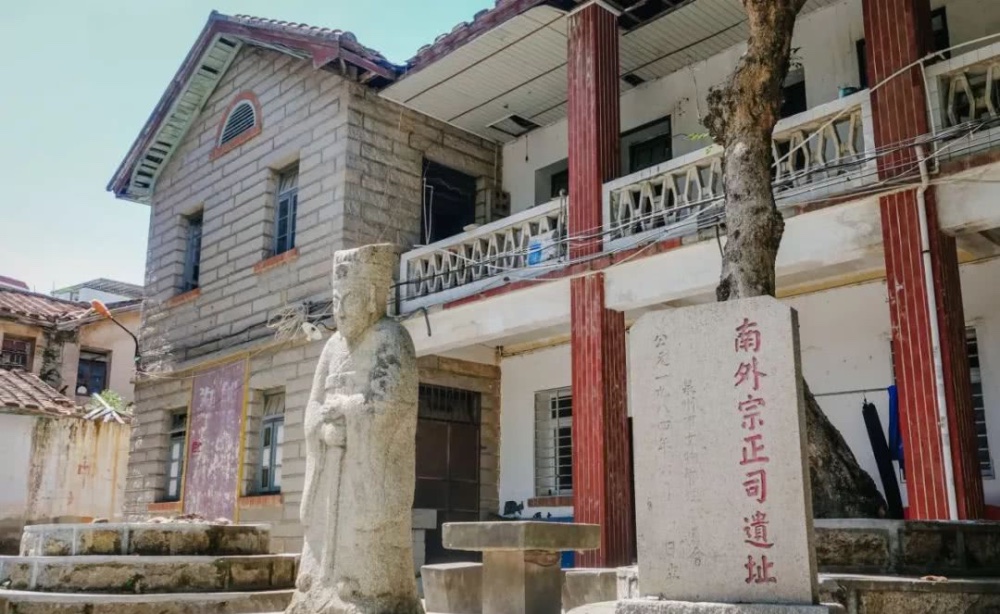
Stone figure and marker at the Site of the Southern Clan Office in Quanzhou

Song imperial institution · Historic Downtown

Site of Southern Clan Office

Foundations, official bricks and inscribed ceramics reveal an imperial community drawn to the wealth of a maritime city.

Chinese map name
南外宗正司遗址 Southern Clan Office
Role in the port
Administration of the Song imperial clan
Historic period
Established after the clan's 1130 relocation
Time on site
Allow 30–45 minutes

南外宗正司遗址

Why did members of the Song ruling family settle in a commercial port?

The Southern Clan Office administered members of the Song imperial family who relocated to Quanzhou from 1130 onward. The site lies southwest of the old Suqing Gate and south of Kaiyuan Temple, placing an imperial institution inside the same city that hosted overseas merchants, workshops and religious communities.

Excavations have found two building foundations, retaining walls, a road beside a pond, roof tiles, ridge ornaments, bricks and ceramics. Some bricks carry the character guan, meaning government. Ink inscriptions on porcelain include cyclical dates and institutional or personal names, clues that connect objects to the office and its residents.

Historian Hugh Clark notes that Quanzhou's wealth attracted the displaced branch of the imperial clan, whose support depended heavily on public resources. John Chaffee goes further, examining how clansmen affected appointments, patronage, landholding and overseas trade. The site therefore links dynastic politics to the port economy rather than treating them as separate worlds.

On site

What to look for

The site becomes more legible when you know which physical clues carry its larger story.

Start with the whole setting, then move closer. Architecture, archaeology and landscape often reveal different parts of the same argument.

Site marker and stone figure at Quanzhou's Southern Clan Office

01

Foundations rather than palace rooms

The visible argument comes from building footprints and stratigraphy. Use the plan to understand scale and organisation instead of imagining a complete surviving residence.

02

Government-marked bricks

The guan character is a small but direct clue to official status. It is stronger evidence for institutional use than later commemorative sculpture.

03

Roof decoration and administrative rank

Lotus, peony, hibiscus and animal-mask motifs appear on excavated architectural pieces. Their quality and form help archaeologists assess the compound's status.

04

Its place south of Kaiyuan Temple

The short distance between clan office, major Buddhist institution and commercial streets shows how different elite, religious and urban functions overlapped downtown.

Stone figure and marker at the Site of the Southern Clan Office in Quanzhou

Read the port system

The port's prosperity drew in the dynasty itself

Clark records contemporary descriptions of Quanzhou as wealthy because its ships traded among islands and overseas regions. That wealth helped make the city capable of supporting hundreds of imperial relatives after the Northern Song collapse.

The clan's presence in turn affected local power and commerce. The office is valuable because it prevents a romantic story in which Quanzhou prospered beyond the state: imperial privilege, official resources, local elites and maritime markets interacted inside the same system.

See all 22 component sites

Research lens

What scholarship adds to the visit

This archaeological site complicates the idea that maritime Quanzhou prospered apart from imperial politics: members of the Song ruling clan lived here in unusually large numbers.

01

An imperial community with local consequences

Chaffee traces how the relocation and growth of the imperial clan in Quanzhou affected landholding, official appointments, patronage and participation in overseas commerce.

Read the source

John W. Chaffee, ‘The Impact of the Song Imperial Clan on the Overseas Trade of Quanzhou’

02

Political status could support commercial growth

The wider research collected in The Emporium of the World treats officials, elite families and financial systems as active parts of the port economy. The clan office gives that institutional layer a physical location.

Read the source

Angela Schottenhammer, ed., The Emporium of the World: Maritime Quanzhou, 1000–1400

03

The argument is larger than the visible ruin

The nomination connects the excavated compound with documentary records of the Southern Clan Office. Its value lies in the combination of texts, archaeology and urban location rather than monumental completeness.

Read the source

Quanzhou World Heritage nomination dossier (2020)

Plan the visit

Make the time on site count

These are planning decisions, not fixed opening-hour claims. Recheck access and transport shortly before travel.

01

Read the excavation first

The contemporary marker is not the main historical object. Begin with the archaeological plan and display information before looking at commemorative features.

02

Add it to a Kaiyuan route

This is a compact specialist stop, most effective before or after Kaiyuan Temple and West Street rather than as a separate journey.

03

Search the complete Chinese name

Use 南外宗正司遗址. English map results may be sparse and pins can point only to the site marker.

04

Allow for changing archaeological access

Excavation, conservation and neighbourhood work can alter what is visible. Recheck local notices and do not cross protected surfaces.

Connect the place

Connect imperial Quanzhou to its Buddhist centre

Walk from the Southern Clan Office to Kaiyuan Temple and West Street. The sequence joins dynastic migration, elite patronage and the everyday city surrounding its largest Buddhist complex.