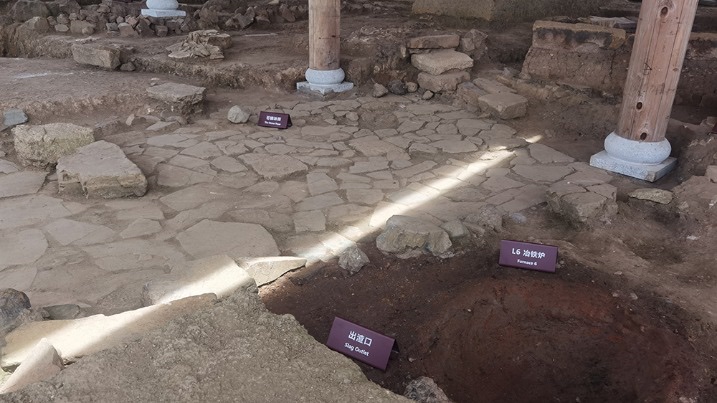
Excavated furnace, slag outlet and working floor at the Xiacaopu iron site

Iron production · Anxi

Xiacaopu Iron Production Site

Furnaces, slag and charcoal expose the heavy industrial work usually missing from stories of porcelain and silk.

Chinese map name
安溪青阳下草埔冶铁遗址
Role in the port
Government-linked iron smelting in the hinterland
Historic period
Production securely dated to the 10th–11th centuries
Time on site
Specialist full-day trip from Quanzhou

安溪青阳下草埔冶铁遗址

What industrial labour stood behind the wealth of a maritime emporium?

Xiacaopu lies on a hillside south of Qingyang Village in Anxi, in the Daiyun Mountains roughly 70 kilometres from Quanzhou. The protected landscape exceeds 10,000 square metres and includes a smelting area, ancient mine pits, an old trail, fuel-producing hills and the ancestral house site of the Yu iron-smelting family.

Excavation and laboratory testing identify a bloomery process using small blast furnaces and charcoal. Sponge iron was produced first, then further heated into ingots before being cast elsewhere. Radiocarbon dates from more than ten charcoal samples cluster around the 10th and 11th centuries, consistent with coins and ceramics recovered on site.

The nomination describes Qingyang as one of the dedicated iron plants established by the Song government. That interpretation places industrial regulation, woodland fuel, mining and transport inside Quanzhou's economic territory. It does not prove that every ingot was shipped overseas, but it does reveal the material base on which regional commerce depended.

On site

What to look for

The site becomes more legible when you know which physical clues carry its larger story.

Start with the whole setting, then move closer. Architecture, archaeology and landscape often reveal different parts of the same argument.

Excavated furnace and stone working floor at the Xiacaopu iron production site

01

Furnaces and slag outlets

Labels identify technical features that otherwise resemble pits and burnt earth. Follow the path from ore and fuel to furnace, slag and bloom rather than searching for finished iron objects.

02

Slag as production evidence

Waste chemistry helps reconstruct temperatures, ore and smelting method. The dark, irregular material is often more informative than the missing metal product.

03

Charcoal and the surrounding hills

Fuel demand tied industrial output to managed woodland. The landscape around the excavation was part of the production system, not a neutral backdrop.

04

Trail, village and smelter lineage

Transport traces and family memory show how labour was organised locally. Keep those later narratives distinct from the securely dated Song archaeological layers.

Excavated furnace, slag outlet and working floor at the Xiacaopu iron site

Read the port system

A port economy consumed ore, woodland, labour and transport

Xiacaopu corrects the tendency to reduce medieval exports to attractive museum objects. Iron production involved extraction, fuel preparation, specialised firing and movement of semi-finished material through the hinterland.

Research on Quanzhou's economy links metals to tools, money and trade, but the site's significance is best stated carefully: it proves substantial Song-period iron production within the emporium's region, not the destination of each individual ingot.

See all 22 component sites

Research lens

What scholarship adds to the visit

Xiacaopu corrects the tendency to imagine maritime trade as porcelain and silk alone: iron production supplied tools, commodities and a material base for the regional economy.

01

Production can be reconstructed from technical remains

The excavation study examines furnaces, slag, ore, charcoal and workshop organisation. These traces reveal production processes that are far less visually obvious than a temple or bridge.

Read the source

Peking University repository: Preliminary Understanding of the Xiacaopu Iron Smelting Site

02

Metals connected policy, money and trade

Schottenhammer's research places metals and changes in Song monetary circulation inside Quanzhou's commercial development. Xiacaopu gives that economic discussion a material hinterland.

Read the source

Angela Schottenhammer, ed., The Emporium of the World: Maritime Quanzhou, 1000–1400

03

The hinterland was part of the port

The revised nomination succeeded by linking production sites to transport and urban institutions. Xiacaopu is important precisely because it lies inland and demonstrates the territorial reach of the emporium.

Read the source

ICOMOS evaluation of the revised Quanzhou nomination (2021)

Plan the visit

Make the time on site count

These are planning decisions, not fixed opening-hour claims. Recheck access and transport shortly before travel.

01

Confirm access before departure

This is a remote archaeological component, not a central tourist attraction with predictable English services. Check current opening and road conditions locally.

02

Use a hired car and exact pin

Save the full name 安溪青阳下草埔冶铁遗址. Arrange return transport in advance and allow substantial road time from central Quanzhou.

03

Bring technical context

Download a labelled furnace diagram or this page. Without an explanation of bloomery smelting, stone floors and slag deposits can be difficult to read.

04

Stay on protected paths

Do not touch slag piles, enter trenches or remove material. Industrial archaeology depends on the precise relationship between small remains and their location.

Connect the place

Use Xiacaopu as a specialist production journey

Do not combine it casually with several distant heritage sites. Pair it thematically with Cizao or Dehua through museum objects before or after the trip, and make the Anxi site the day's main purpose.