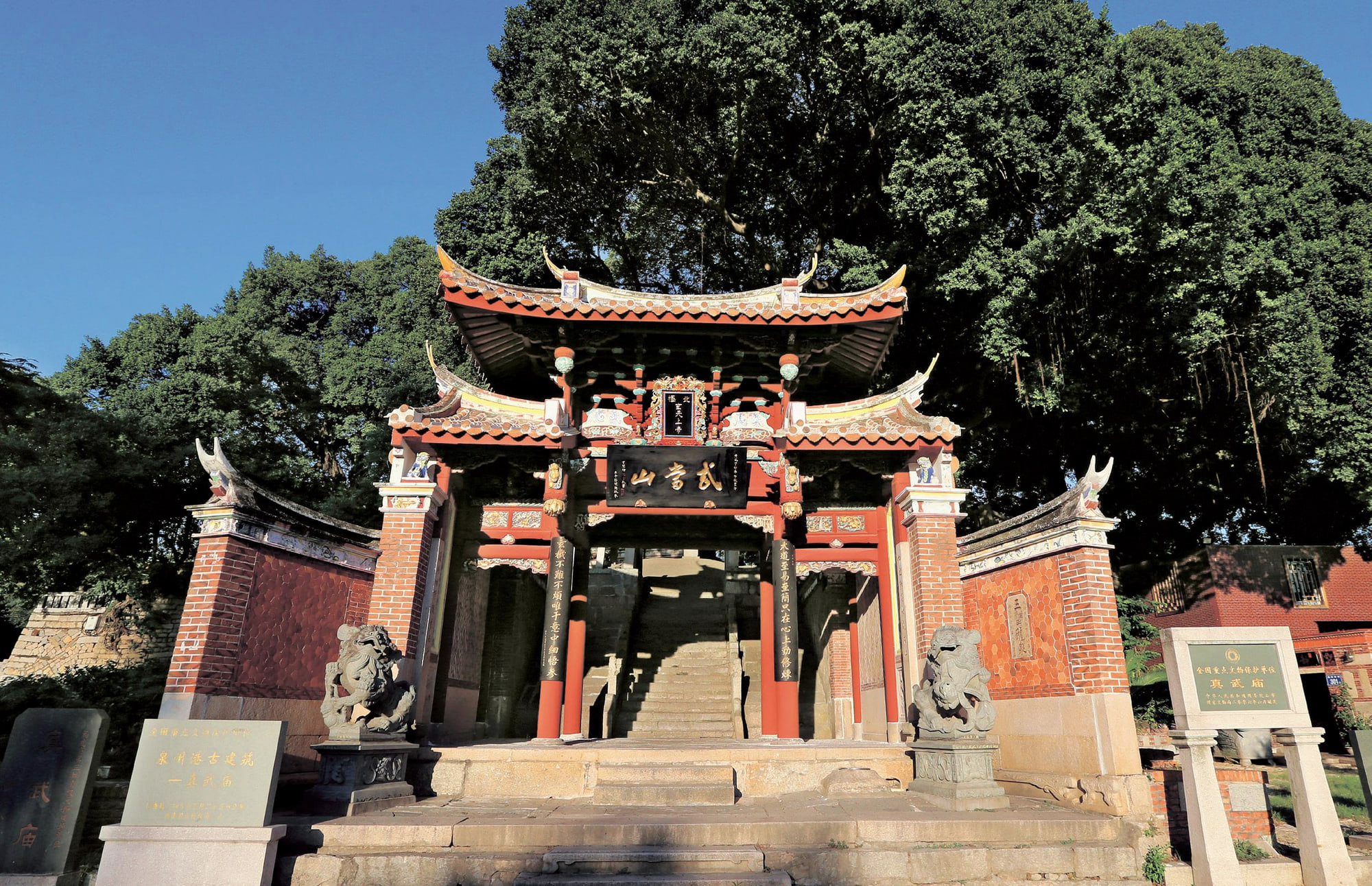
The entrance gate of Zhenwu Temple in Quanzhou

Temple and port landscape · Estuary

Zhenwu Temple

A Daoist temple above the former Fashi inner port, where officials, merchants and the river landscape met.

Chinese map name
泉州真武庙 Zhenwu Temple
Role in the port
Sea ritual and landmark at Fashi Port
Historic period
Founded in the Song period; later rebuilt
Time on site
Allow 45–60 minutes

真武庙

Why did officials perform sea rituals on a hill above an inner port?

Zhenwu Temple stands on the northern bank of the Jin River at the foot of Stone Mountain, overlooking the area of Fashi, one of medieval Quanzhou's inner ports. Founded during the Song period, the Daoist temple was dedicated to Zhenwu and became a place where officials made sacrifices to the sea.

The present complex climbs from an entrance gate through 24 rock-cut steps to a pavilion and main hall. Song-period stone handrails and carved lions survive along the ascent. A turtle-and-snake-shaped rock, the emblem of Zhenwu, carries the later Tunhai or ‘Devouring the Sea’ inscription erected in 1533.

The temple's significance is geographical. From this raised position, belief, official ceremony and the working waterfront could be held in one field of view. Modern construction has altered that relationship, so the nearby estuary docks and historical maps help restore the missing port context.
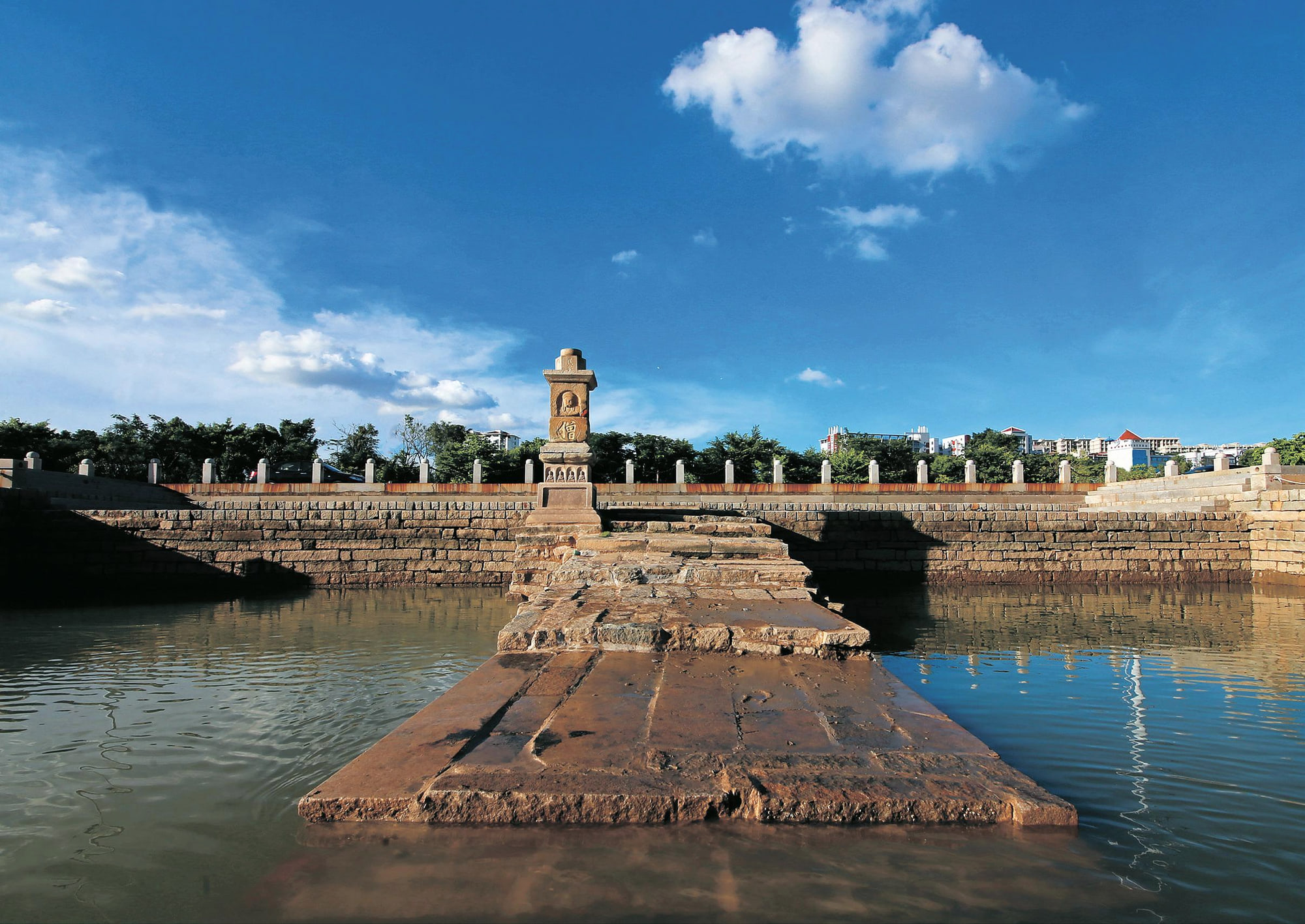
On site

What to look for

The site becomes more legible when you know which physical clues carry its larger story.

Start with the whole setting, then move closer. Architecture, archaeology and landscape often reveal different parts of the same argument.

Historic dock masonry on the Jin River near the former Fashi port

01

The climb as ceremonial sequence

Gate, steps, pavilion and hall rise with the slope. The movement upward is part of the architecture rather than simply access to a building at the top.

02

Song stonework among later fabric

Locate the old handrails and lions beside the 24 steps. They should be distinguished from timber and decorative work renewed in later periods.

03

The turtle, snake and Tunhai stele

Zhenwu's paired animals appear in the natural rock form. The 1533 inscription belongs to a later historical layer and shows the site's continuing maritime symbolism.

04

The direction of the former port

Look west and towards the river, then compare the view with the position of Wenxing and Meishan docks. The site makes sense as part of Fashi, not as an isolated hillside shrine.

The entrance gate of Zhenwu Temple in Quanzhou

Read the port system

A temple could be part of the port's working landscape

Quanzhou's maritime system included institutions that addressed danger and uncertainty. Officials used Zhenwu Temple for sea sacrifices, while merchants drew spiritual support from the same sacred landscape. The relationship was practical, civic and devotional at once.

Pairing Zhenwu with the Estuary Docks reveals the division of labour in the inner port: boats transferred cargo at water level, routes led towards the city, and an elevated ritual site looked over the whole approach.

See all 22 component sites

Research lens

What scholarship adds to the visit

Zhenwu Temple makes the port landscape readable because its meaning depends on where it stands above the former Fashi inner harbour.

01

Topography carries the argument

The nomination links the temple to the estuary, nearby docks and the route into the city. Its elevated position joined protection, visual command and the maritime approach to an inner-port district.

Read the source

Quanzhou World Heritage nomination dossier (2020)

02

Ports extend beyond waterfront masonry

Pearson, Li and Li reconstruct Quanzhou through ships, docks, temples, tombs and kiln sites. Their archaeological approach helps explain why a religious site overlooking water belongs to port history rather than a separate category of belief.

Read the source

Richard Pearson, Li Min and Li Guo, ‘Quanzhou Archaeology: A Brief Review’ (2002)

03

Modern change can obscure historic connections

ICOMOS identifies rapid development and altered settings as a risk to understanding several components. Here, historic sightlines and the relationship to the water require deliberate attention because the contemporary city no longer looks like a medieval harbour.

Read the source

ICOMOS evaluation of the revised Quanzhou nomination (2021)

Plan the visit

Make the time on site count

These are planning decisions, not fixed opening-hour claims. Recheck access and transport shortly before travel.

01

Pair it with the docks

The temple alone takes less than an hour, but the historical argument is much stronger when it is connected to Wenxing or Meishan Dock on the same excursion.

02

Expect steps and uneven surfaces

The short ascent includes historic stone. Wear secure footwear and allow extra time in rain or high humidity.

03

Use the Chinese map name

Save 泉州真武庙 and show the pin to a driver. It is outside the most convenient old-city walking circuit.

04

Read later additions by date

Do not assign the 1533 stele or present halls to the temple's Song foundation. On-site dates help keep the surviving layers clear.

Connect the place

Build a Fashi inner-port route

Visit Zhenwu Temple with the Estuary Docks and, if time allows, the Quanzhou Maritime Museum. The route connects port landscape, ship archaeology and maritime ritual.