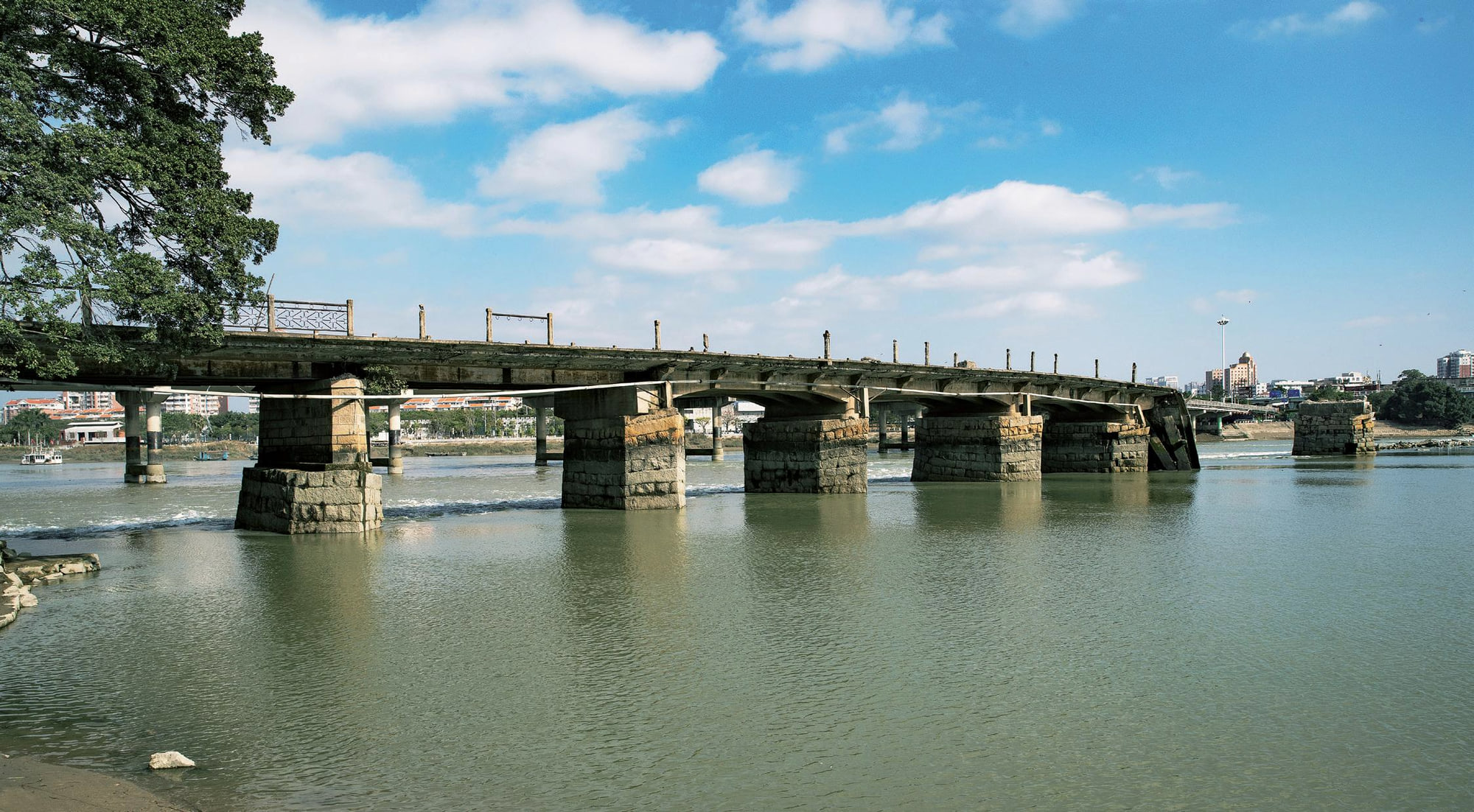
The surviving stone piers and spans at the Site of Shunji Bridge

Bridge archaeology · Jin River edge

Site of Shunji Bridge

Eleven surviving pier sites preserve the line of a bridge that once carried the southern city across the Jin River.

Chinese map name
顺济桥遗址 Shunji Bridge Site
Role in the port
River crossing at the southern city entrance
Historic period
Built in 1211; repeatedly repaired until the 20th century
Time on site
Allow 30–45 minutes

顺济桥遗址

Can a broken bridge still explain how the city worked?

Shunji Bridge was built in 1211 under Quanzhou governor Zou Yinglong. It crossed the Jin River immediately outside Deji Gate and took its name from nearby Shunji Temple, now Tianhou Temple. The bridge served the main route between the commercial city and the river's south bank.

Historical records describe a crossing more than 150 zhang long, about 1.4 zhang wide and supported on 31 piers. Builders used raft foundations related to the methods at Luoyang Bridge: stone was spread across the riverbed, slabs were laid in crossing layers to form piers and stone beams carried the deck.

Only portions of deck and 11 pier sites remain. That loss does not remove the bridge from the port system; it changes the kind of visit. Alignment, surviving masonry, records and the relationship with Deji Gate preserve a transport node whose complete superstructure no longer exists.
On site

What to look for

The site becomes more legible when you know which physical clues carry its larger story.

Start with the whole setting, then move closer. Architecture, archaeology and landscape often reveal different parts of the same argument.

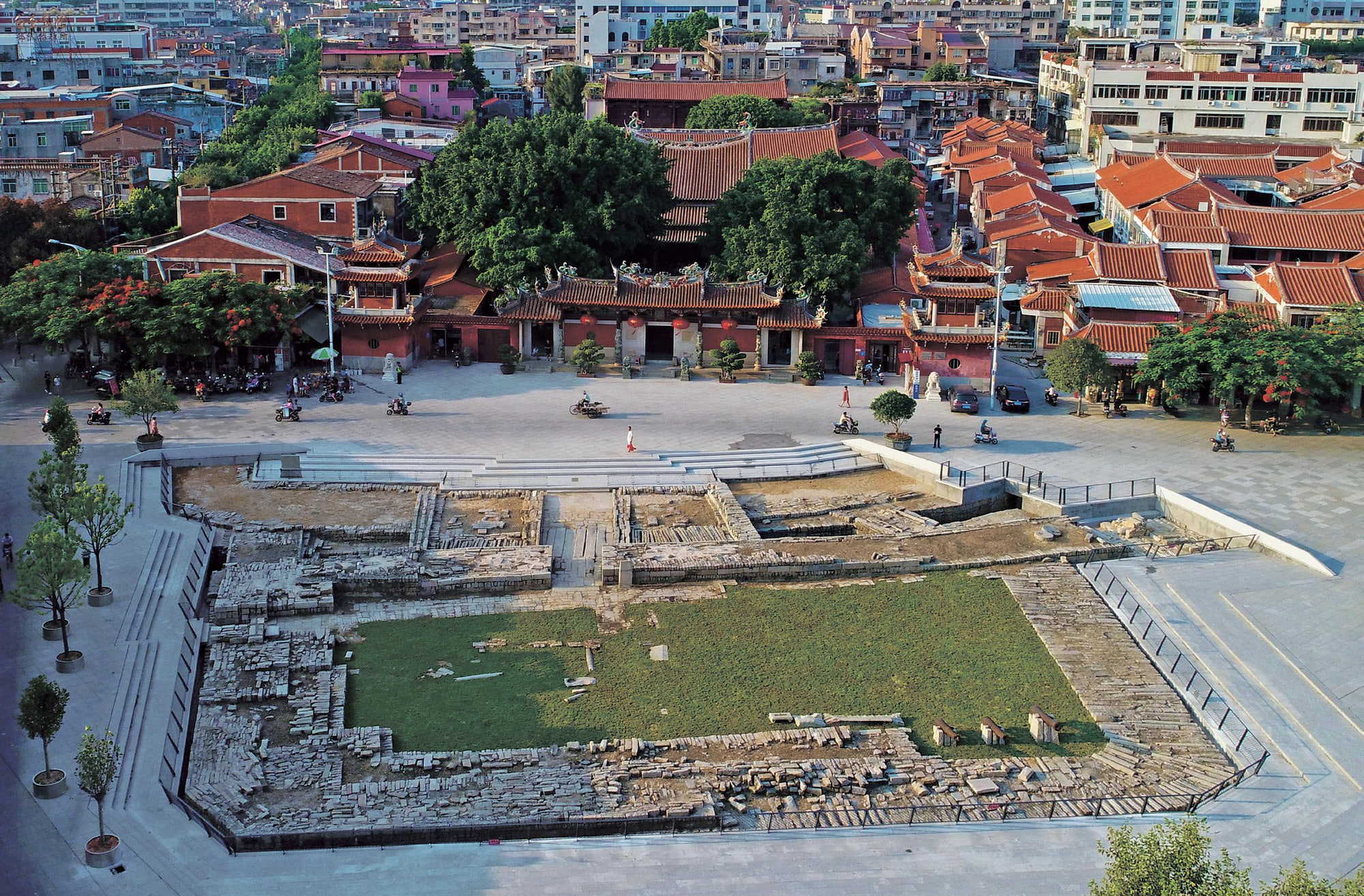
Deji Gate foundations at the city end of the former Shunji Bridge route

01

The line across the river

Identify the sequence of surviving pier positions before focusing on individual stones. Their alignment reveals the former crossing more clearly than any one fragment.

02

Raft-foundation evidence

Low masonry at water level relates to techniques developed for tidal and river crossings. River engineering, not height, is the bridge's central achievement.

03

Surviving versus reconstructed information

Separate what remains on site from dimensions known through historical records and what appears only in photographs or diagrams of the former bridge.

04

Deji Gate behind the bridge

Turn towards the old city. The gate, Tianhou Temple and crossing formed a sequence that channelled movement from the south bank into Quanzhou's commercial streets.

The surviving stone piers and spans at the Site of Shunji Bridge

Read the port system

The bridge completed Quanzhou's southern water-and-land transfer route

Shunji Bridge linked river transport to the main commercial district. Cargo and people did not simply arrive at a dock; they needed controlled crossings, streets and gates to enter the urban economy.

The site's fragmentary condition is also a conservation lesson. Flood, changing hydrology, modern river works and maintenance decisions are part of the history of infrastructure, which survives differently from a protected temple courtyard.

See all 22 component sites

Research lens

What scholarship adds to the visit

Shunji is valuable precisely as a damaged archaeological site: absence and surviving piers reveal how dependent the southern city was on a crossing that later failed.

01

A bridge completed the southern commercial route

The nomination connects Shunji Bridge with Deji Gate, Tianhou Temple and routes across the Jin River. Together they formed a sequence from city streets to river movement.

Read the source

Quanzhou World Heritage nomination dossier (2020)

02

Ruins preserve network evidence

Pearson, Li and Li's port-and-hinterland approach helps readers value foundations and partial structures. Even without a complete deck, alignment and surviving masonry identify a former transport node.

Read the source

Richard Pearson, Li Min and Li Guo, ‘Quanzhou Archaeology: A Brief Review’ (2002)

03

Loss is part of conservation history

ICOMOS assesses integrity and environmental risk across bridges and waterfront sites. Shunji demonstrates why hydrology, storms, urban works and maintenance must be included in the story of a heritage structure.

Read the source

ICOMOS evaluation of the revised Quanzhou nomination (2021)

Plan the visit

Make the time on site count

These are planning decisions, not fixed opening-hour claims. Recheck access and transport shortly before travel.

01

Use historical images on site

A plan or old photograph makes the remaining pier line much easier to interpret. Download one before travelling if English panels are unavailable.

02

Do not expect a walkable crossing

This is an archaeological site, not a complete bridge route. View it from designated areas and do not climb onto isolated masonry.

03

Link it with the southern gate

Visit Deji Gate and Tianhou Temple before or after the river edge. Their relationship supplies the urban context missing from the ruin alone.

04

Check river-edge conditions

Rain, high water, construction and vegetation can affect visibility and access. Follow local barriers and current notices.

Connect the place

Reconstruct the southern entrance to Quanzhou

Move from Shunji Bridge Site to Deji Gate and Tianhou Temple, then continue north along Zhongshan South Road. The route follows the historical transition from river crossing to city streets.